“Ni carn ni peix.”
This phrase in Catalan is one that any regular reader knows I keep coming back to as I simply love it. “Neither meat nor fish” is the literal translation, but the implied meaning is that something (or even someone) is simply undefined and unable to be classified and it applies no better than to the ‘advertorial.’
These arrive to us under a variety of names whether it be: “sponsored content”, “promotional feature”, “advertising supplement”, or many, many others. The concept is the same in that they’re paid advertising dressed up to look like regular editorial in a publication. Thus while 100% advertising, they’re also ‘content’ and in turn, ni carn ni peix.
The Merriam-Webster dictionary states that the first known use was in 1917, so they’ve been around longer than any of us have been alive. All my life it’s certainly felt this way and to some degree, many publications are largely advertisements anyways, so the point at which actual content and that paid for by an advertiser begins and ends is hard to ascertain in a modern context.
I know this well from my stint working as the IT Director for San Francisco and Diablo magazines. Our most stressful time was just before publishing as we needed to get all of the various advertising materials to be standardized in the print publication. This was no small task, especially as they comprised at least 80% of the final print product.
Wine on a hill?
Perhaps I’m biased as I write almost completely for wine media these days, but since the modern, English-language inception 50 years ago with the creation of Decanter and Wine Spectator, it seemed like there was always a separation of church and state. Ads were quite clearly ads and editorial, editorial. Unlike lifestyle magazines (such as San Francisco and Diablo magazines), wine publications needed a sheen of authority given that, in addition to their writing, there were also qualitative reviews being dished out. If one was to cross the line, it would surely mean the end of that publication’s credibility, no?
But then somewhere around a decade ago (I’m very happy to be corrected on this), the advertorial creep started with earnest in wine publications. The initial phases were large, glaring, different-looking “supplements” and the such for regions or at times, deep-pocketed wine groups. It wasn’t necessary to label that this was paid-for content given that it was quite clear and there would also be a few pages with something along the lines of, “Brought to you by the region and tourist board of This & That”.
For a time, this seemed to work for everyone, but then one by one, various established wine publications noted that their contemporaries were running one, then two, and then more than a few of those ‘special’ pages marked with “A word from our partners” or what have you at the top. Now, literally everyone established is doing it, including a venerable UK publication that had prided itself on independence up until the last year or so.
Perception? Perschleption!
Suffice to say, the advertorial is now everywhere and, much like the Kardashians, appears to never be going away.
Personally, I’ve hit something of a breaking point with them which came about on two fronts.
The first moment was the penultimate time I was judging for a large wine award venue when one of the editors from the publication running it stated, “Oh, the Promotional Features? The clients love them!” Because, of course they do as they nearly look like proper, respected editorial and, no matter the little bit at the top, there is a undeniable foundation which is to deceive the reader. If this wasn’t the case, then they wouldn’t look like magazine copy, but sunlight-hued shots of the winemaking family, noses in glasses, in a rustic barrel room.
This gets into the second point in that a side gig for many writers, myself included, has been to write the copy for these pieces and we usually do it without a byline. You’re given a list of what the client wants there to be in it and supposedly there’s ‘independence’, but I have a hard time buying that given the nature of the arrangement. I know very well from one experience that despite being paid for my writing, it wasn’t ultimately published as the client, “decided to go in another direction” so there is a level of final sign off that fully negates any claims of “editorial independence.”
It was in one piece I wrote for a region in Spain that, once published, the region began sharing everywhere stating on social media, “Look at what This Publication is saying about us!” Again, it was them paying the publication who paid me to write exactly what was to be said. I won’t lie in that I felt very dirty and haven’t written this type of work since.
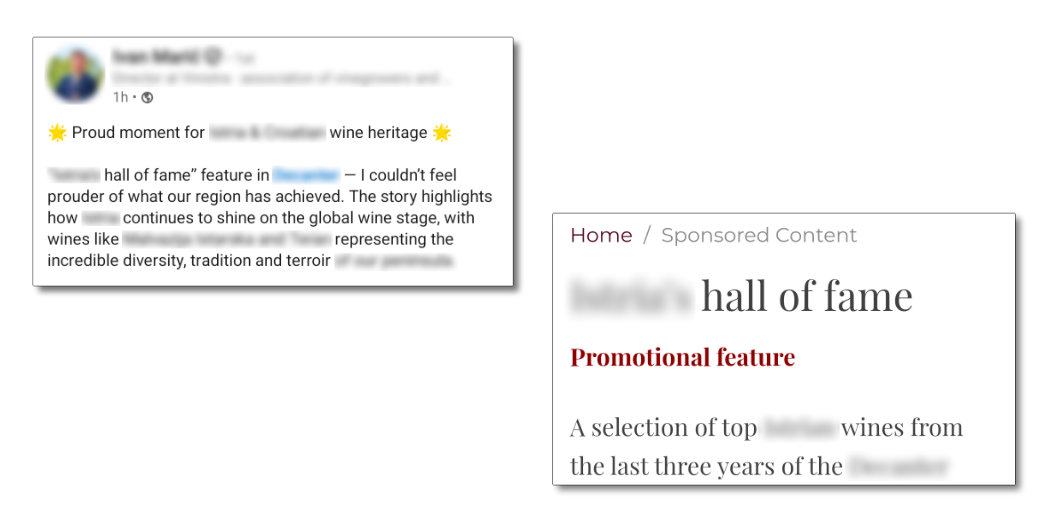
I see that it’s only gotten worse as shown by the lead image for this article wherein the president of the region is doing the same thing as the Spanish region I wrote for. I had nothing to do with this article above, but it was 100% paid for as shown by the related piece he was promoting on LinkedIn. He’s extremely ‘proud’ of paying off a publication to talk positively about them. Am I the only one who finds this absolutely bonkers?
Moving the needle?
I’m leaving this article free and open for anyone to read and comment on as I’m very interested to hear feedback from people about advertorials:
- How do you feel about this form of advertising?
- As a wine drinker would you ever buy anything promoted by these?
- As a reader, does it affect your opinion of the publication when you see these?
- If you’re a region/producer that’s paid for one, do you find that there’s any demonstrable return one your investment?
- Also, if you’re a region/producer, do you feel there’s a potential backlash in that it shows you have to pay off a publication to receive glowing coverage?
Please feel free to contact me directly if you’d wish to have a response posted anonymously or just send me feedback if not even for posting. I’m definitely open to hearing about people’s positive experiences as we’re in uncharted waters these days in terms of wine media, but as you can see from past experience, I’ll need a good deal of convincing to see how this how scenario isn’t awful for everyone except a publication.
With the ever-growing tsunami of AI slop that’s washing over us currently, it feels like there is more need than ever for authentic, real content, and the advertorial is anything but. Perhaps this is why WineStack has grown so much or perhaps it’s the latest step in a much-needed evolution when it comes to writing about humankind’s oldest booze.
If curious please read the disclosures for this publication and the corresponding The Hudin Letter.



I think that we have to admit to ourselves that most wine publications exist mainly to sell wine. At the most basic level, it starts with the samples that wineries, etc. send in for tasting and evaluation. They do this in the hopes that their wines will show up somewhere in the publication. The magazines encourage this with competitions as a means or revenue, as a means of promoting themselves and ultimately as a means to keep publishing. Big wineries, associations, regional councils, etc. are, I imagine, very eager to get their products in print and will offer access and assistance in a sort of quid pro quo. The advertorial is only the logical consequence of all this.
I would counter argue that salespeople exist to sell wines. The original intent of wine publications was to cut through the madness for paid subscribers and help guide people in choosing what to buy amongst the offer of hundreds of thousands of references. If it’s the fact that they’re functioning purely as a sales mechanism, then they are, definitely obsolete and it’s part of the reason that I’ve been hearing of cancelled subscriptions mounting rapidly.