I realize that I might finally be ‘old.’
I say this as I can more or less remember a time when Twitter was a (generally) fun place to exist. There was this little corner that wine inhabited on the platform which could offer up informative discussions or impassioned arguments that one would stand back from and watch from afar with bemusement.
While ‘natural’ wine has always been a topic as combustible as the wines are unstable, a second item that would juice the angst on Twitter, was any discussion about how to seal bottles of wine.
Coming from a technology background, I’ve always taken the stance that if something works, use it. Thus, while my working preference is for Windows systems, I can readily use a Mac if it’s the computer being offered.
This is not the case in wine. While there are those who take my approach, there are others that will wish horrid things on your firstborn child if you’re to infer that anything other than natural cork may be inserted into a wine bottle to stop the beautiful liquid inside from falling out.
I’ve mused about the issues in using natural cork in the past and I’ve also run my own personal experiments with these natural as well as ‘technical’ corks. The latter being those made of a cork base, but aren’t extracted from the bark of the cork oak (quercus suber) in one piece. My conclusions were that it was hard to really arrive to any conclusions which is why I was very excited to be invited by Cork Supply on a whirlwind tour of their facilities that stretch across the northern portion of Portugal.
Cork Supply is one portion of the larger Harv 81 Group that was founded by German, Jochen Michalski. What’s interesting is that he didn’t set out to be a cork producer originally as back in 1981, he was living in California and working to import and sell corks.
This was a rather dark time for corks as the number of problems were tremendous, especially around the issues of TCA. It’s technical name, 2,4,6-Trichloroanisole may leave most a bit cold which is why we use its simpler consumer name, ‘corked.’ It’s a chemical compound that, once entering a wine will eventually destroy it. If you’ve encountered a musty, cardboard smell to a wine and found that when tasting it, it’s completely flat, that’s a wine infected with TCA.
It was running rampant through the cork industry and led to such things as basically all the production of Australia and New Zealand shifting to screwcaps due to receiving truly awful corks. As time went on, the problems shifted more to secondary wine markets (essentially anyone not in France, Italy, Spain, Portugal, Germany, Austria, or the US) who were clearly getting the less interesting corks.
I heard that one producer was actually buying his European-made corks from a Californian producer who sent them back to Europe and the producer’s winery in Croatia. The idea was that no one would dare to sell a faulty cork to an American as they’re so litigious that they’d risk being sued. Such was the insanity in the messy period of corks before well-made technical corks arrived on the scene.
Despite all of this, most people still wanted wines sealed with corks as shown by the often-rabid fights on Twitter. Michalski could clearly see issues and started moving to control his own supply. Then, as a secondary measure, he started investing in alternatives.
The path of the company over the years has too many steps to get into, but one of the key issues was to first clean up the cork, at the supply point.
Sure, it makes sense now.
The way cork production works in Portugal (which controls half the entire global production) is that the domestic cork is sourced near Lisbon as well as points further to the south and also in nearby Spanish regions. Then, it’s processed up by Porto, which is about a three-hour drive to the north from Lisbon. It doesn’t really make any sense logistically, but it’s how it was established and undoubtedly, how it will continue.
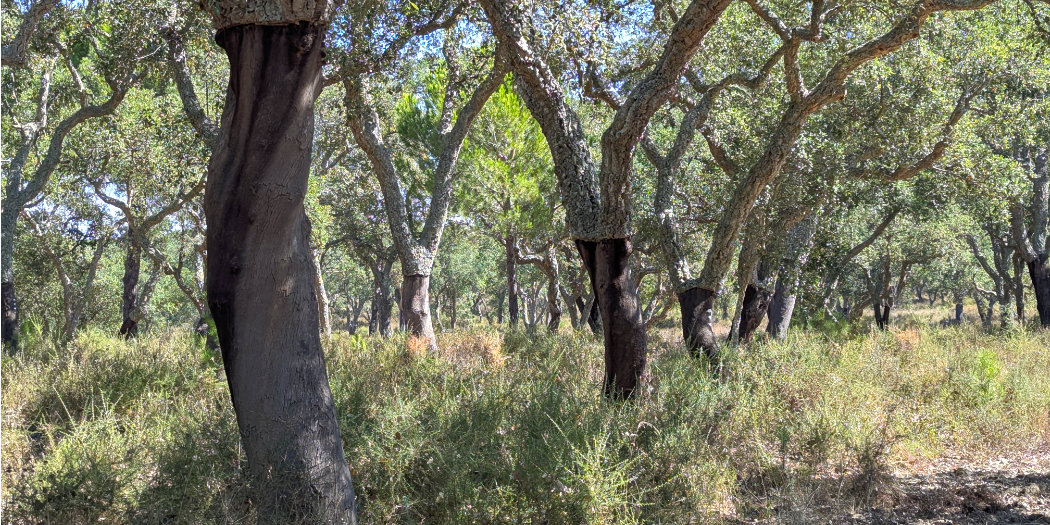
Thus, once arrived to Lisbon, I was driven out to a cork forest not terribly far away. At the wheel of the pickup was Federico Mayer. He drives just like my Portuguese grandfather, very, very fast, but still sane when compared to drivers on Madeira.
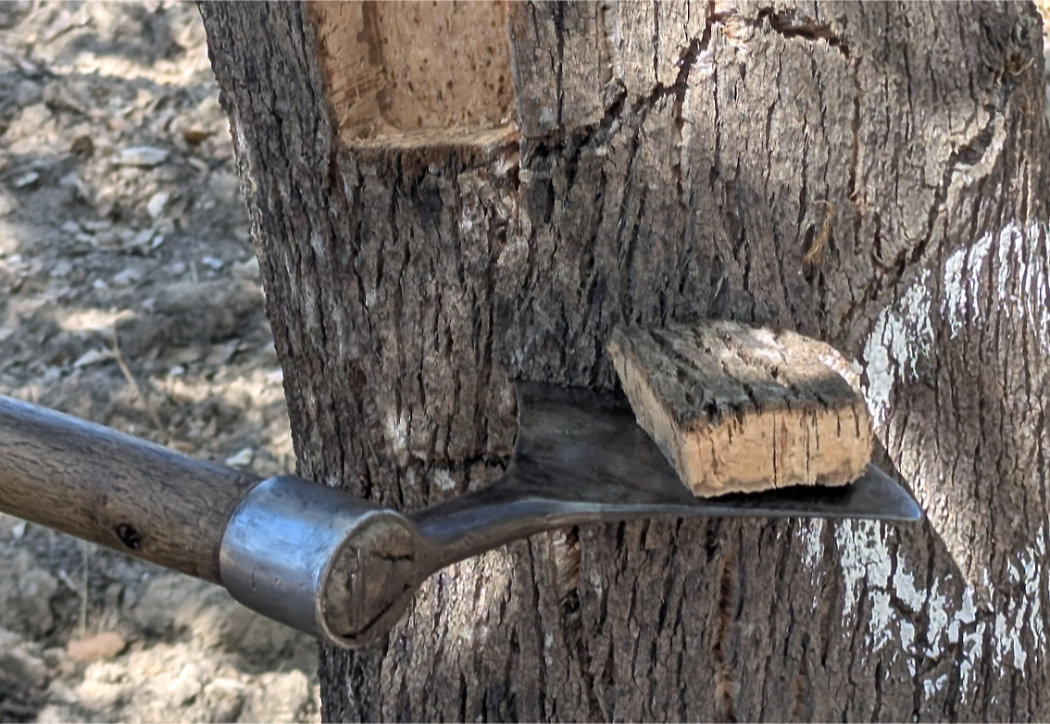 Mayer would be at the top of my list were I to make a bad, late-night decision to get into a knife fight in Portugal. Swarthy and extremely fit, I’m sure he’s older than me but the man looks like if the end of the world was coming, you’d want to get behind him and let him lead you to safety. He’s an artist with the specialized axe that they use to inspect the bark of the cork oak as well as strip the trees in the harvest that happens every nine years or so.
He extracted a perfect chunk from a tree to show how it’s going to be harvested in the near future. I’ve seen cork oaks before as they grow in Catalunya as well, but the density of trees in Portugal is much higher and, according to Mayer, the cork is better on their side of Iberia, including the bits across the border in Spain. Even without the axe in hand, I’d still take his word for it as he drives tens of thousands of kilometers each year searching for the best cork.
Looking beyond the axe however, Mayer pointed out that one of the first ways to massively reduce the amount of TCA in the cork, was to simply not take the bark from the first few centimeters where it touches the earth and the fungus exists that causes the chemical reaction. Seems common sense, except that it wasn’t until only a couple of decades ago. The issue is that it’s tremendously hard work to strip cork bark as it’s in the middle of summer, the general rejection rate is very high, and the renewal of the tree takes years, so people were historically taking in all that they could.
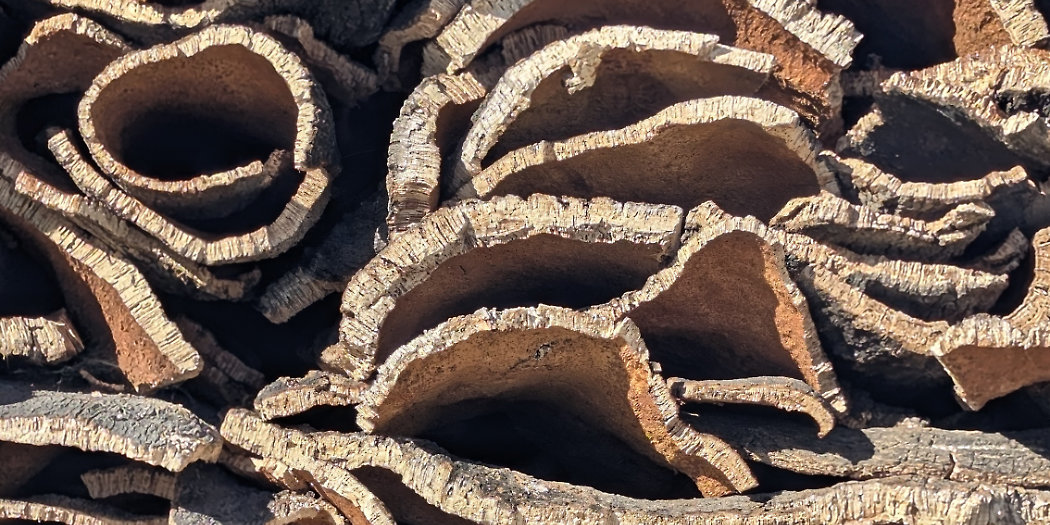 Then, once the bark is stripped by the harvesters (each with their own, signature axe) they arrive to an initial warehouse near Lisbon to dry. Instead of just leaving them out in the weather, they put a tarp across the top to stop water from penetrating and mold from growing. Again, a simple act, but one which has massively reduced problems in the cork.
There will be machines!
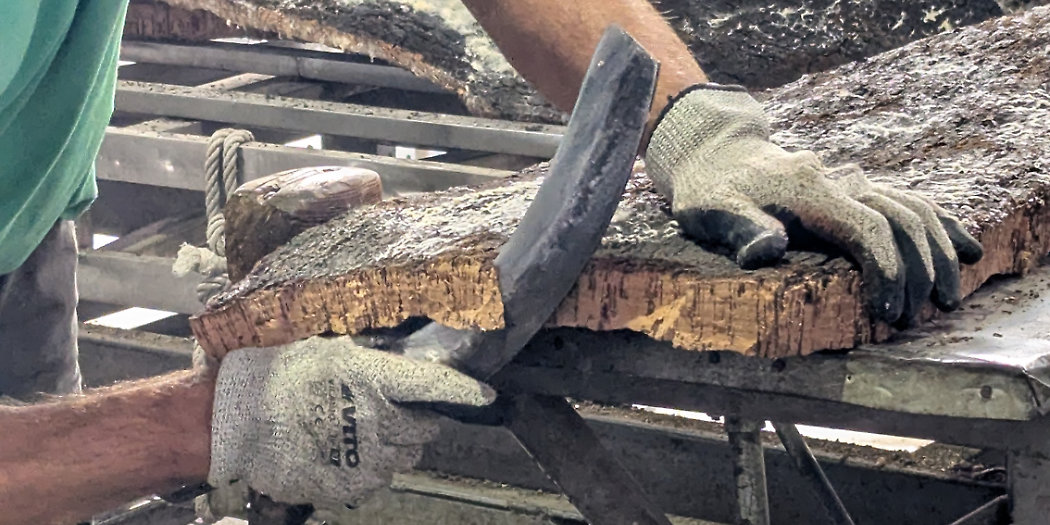 Several steps pass for any potential cork running this circuit, starting with a rough, visual inspection where a couple of guys are tossing out undesirable chunks. But it’s at the main processing plant (we’re up near Porto now) where the corks run though various machines that analyze them for defects. There’s X100 electromagnetic imaging and Vocus, which are seeing their use grow each year. I’m no engineer nor chemist, so I’m at a bit of a loss as to everything they do, but they do work and take no end of manual labor out of the process. I was also to find out that they’re actually better than we mere humans.
Then there’s the DS100, which is “dry soak, 100% inspected” and they put two corks into a jar with a bit of water, with human noses, not machines passing over them. The room where they do this is immense and the work, intense. Myself and the others I was with tried sniffing some and I couldn’t understand some of the rejects, but apparently better safe than sorry.
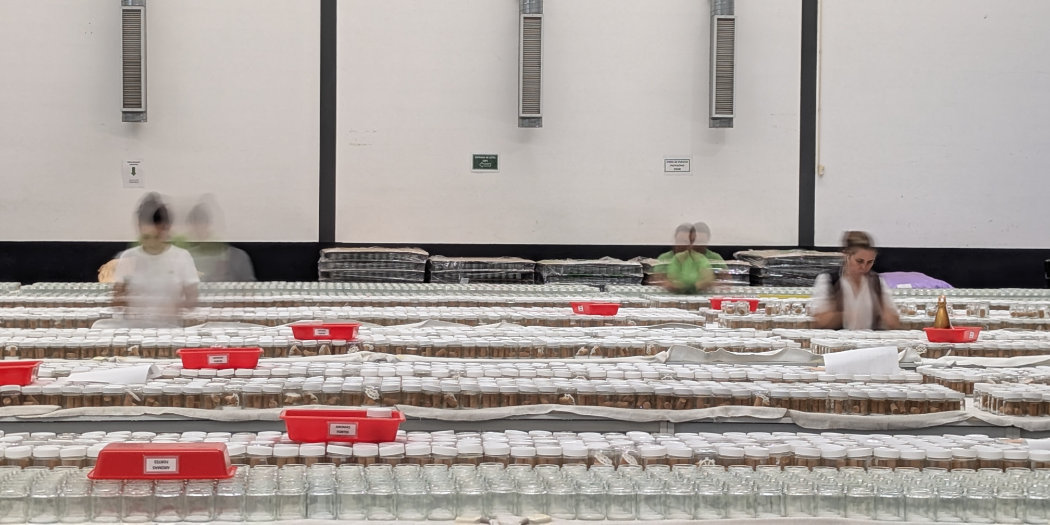 In what was a man vs. machine trial, they had my group manually sniff through selected corks and compare that to the results of the machines. I’m quite proud to say that we were the first people to do this in one of the cork tours. I’m also quite proud to say that Cork Supply never wants me to test corks as while the group was handily bested by the machine, I personally did terrible. My love of the machine rapidly grew at this point in the tour as it seems to show that the technology does indeed work. They’re planning to add ‘AI’ to it in some fashion in the future, but I have no idea why and I feel everyone is dropping this into development chats as it’s the latest buzz, much as how I’m again old enough to remember when “going online” and “deploying an app” were the latest and greatest.
All of this is to say that Cork Supply and the larger Harv 81 Group have invested heavily in bettering the quality of corks on many, many fronts. If all this isn’t enough and a wine still somehow gets tainted, they’ll refund the price of the wine, no matter what the cost.
Is it enough to make me bend the knee to the former Cork Twitteratti? Perhaps, but for those who still aren’t convinced Michalski and now his daughter, Monika Michalski (born in the US and a professional football player prior to joining the company) have continued to work on a broader portfolio for those who still want choices.
To cork or not to cork
While they produce 1.1 billion corks per year, they also have a company producing 10,000 oak barrels, and another producing 105 million labels. Basically, they’ve covered all aspects of everything around sealing wine, including screwcaps with their Maverick brand.
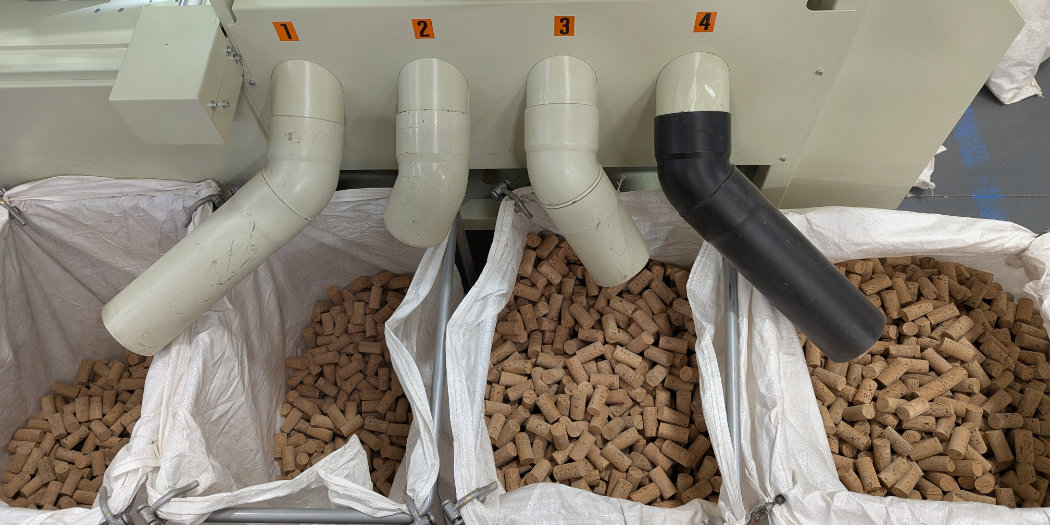 But it’s the ‘technical’ cork aspect that I was yet to see which they produce under their Vinc brand. This is quite interesting as unlike Diam, who have become a superpower in terms of alternatives to fully-natural corks, Cork Supply makes use of all their discard and non-tainted cork. Diam uses about 70% actual cork in their stoppers whereas Vinc is 75% and the Natura line is 90%.
The factory where they produce this is also near Porto, but is a very, very different affair. They chop up the pieces from the cork material and while there’s a tremendous amount of ventilation, it’s still dusty. It’s also very hot as they need to treat the corks and press the granules into the final cork form. And, it’s very, very noisy. It was far too much for me and while most everyone working there had earplugs, some did not and I can’t understand how they did it.
But the result of this work is capturing a great deal of what would otherwise be waste and creating a TCA-free stopper that has a perfect consistency to it. While they do treat the corks, it isn’t the extreme measures used by Diam as the cork being used is from their own, tested leftovers. Whatever is left beyond this goes into other, non-wine stopper products, so there’s surprisingly little waste in cork production.
Ultimately, there was a small tasting test at the end of the factory tour which featured a wine from the Loire Valley that was sealed using a natural cork and then three variants of their technical corks. I have to say that the natural cork was definitely my favorite of the group, but it was something of an odd test given that the wine was a natural producer so it wasn’t a terribly stable wine. It would be interesting to do the test with more standard, stabilized wines to see how things turn out.
It was an extremely eye-opening visit. While Cork Supply isn’t the biggest cork producer (that would be Amorim), they are taking evolution and improvement very seriously.
 If a consumer encounters a corked wine, they may think that it’s the fault of the producer. If the producer runs a clean operation (TCA can exist in a winery), they know it’s the fault of the cork provider and will drop them in an instant if there are too many problems. Thus, it’s fascinating to see all the work that’s happened to date by Cork Supply to improve and continue to improve corks going forward, especially on the machine front. That’s a particular aspect to changes in the world of cork that just might see the Cork Twitteratti experience something no one on social media usually gets to experience: being proven right.