If visitors to Spain move on from Barcelona and start heading away from the Catalan Coast, towards Madrid by train, there’s a point where they begin to rapidly pick up speed. I often wonder that, just as this is happening if they look at the horizon and wonder, “Wow, what on earth is that?!”
At 60m in height, on top of a hill, the tower of la Seu Vella in the city of Lleida can be seen from many points around the province, but it’s clear that most people don’t hop off the train to investigate. The numbers prove this. There were a record-breaking 20 million people who came to Barcelona in 2025. For Lleida, the official numbers are 1.4 million and I suspect that’s for the entire province and most of it is going to be local, not international visitors.
It’s always been a curiosity for me as while Lleida doesn’t have a coast, that’s about the only thing it doesn’t have. There are mountains and valleys and rivers and forests, hiking and skiing, and just about anything anyone could want from a non-seakissed land. But, on top of that, there’s also tremendously-good food and most importantly, wine produced under the region of DO Costers del Segre.
Those river slopes
I realize anyone reading this might immediately say, “Whatsers del what?” My reason for this assumption is that unless you live in Catalunya, Costers del Segre (or slopes of the Segre River) is a region that you’ve probably never heard of. This isn’t unreasonable as it’s the most interior one there is, more or less continental in climate, and makes for a sharp difference when compared to the DOs that hug the Mediterranean coast.
It might also be a bit intimidating as a mishmash of different climates, nearly 30 permitted grape varieties (13 red, 16 white), seven subzones, and winemaking approaches that vary as much as everything else put together. This is why it’s easier to look at it in terms of the lower hills, middle plain, and upper mountain regions. These don’t take into account all the finer details, but it makes it a lot easier to digest what is a huge region being nearly 200km north to south and 100km wide making it a touch smaller than the island of Puerto Rico.
It’s seen a great deal of growth over the last two decades as it’s historically been a massive grape growing region in centuries past. But that fell into decline and then started to pick back up during the later part of the 20th century as many people planted grapes to sell them to larger wineries, especially given that Cava can be produced from a good portion of the territory.
The prices however, collapsed and this is one of the common stories that joins may of the current wineries. They started due to having a wealth of grapes at their disposal and seeing that making their own wines was the far better path forward.
Another land that sparkles
Another aspect that binds together much of Costers del Segre is that sparkling wine aspect. I realize that the concepts of sparkling wines in Catalunya are a touch confusing at the moment. But, while there are all these various parts to Costers del Segre, very nice sparkling wine can be produced, although it won’t be labelled as Cava for the most part.
Costers del Segre producers also have access to a great many grapes such as Chardonnay and Pinot Noir which are core to classic sparkling wine production, in addition to others from Spain like Macabeu. So, what may have seemed like an afterthought years back is now something quite serious.
L’Olivera and Analec both have a strong offer and others produce one or two wines, but of real note when traveling about the entirety of the region are the white and rosé sparkling wines of Costers del Sió. The rosé in fact is one of the finest sparkling wines I’ve had in Catalunya and I don’t make that comment lightly.
While all of the region continues to evolve, I’m sure that there will be much more to say about the sparkling wines going forward as they’re popular and very gastronomic in a destination with excellent food.
The ‘lower’ hills
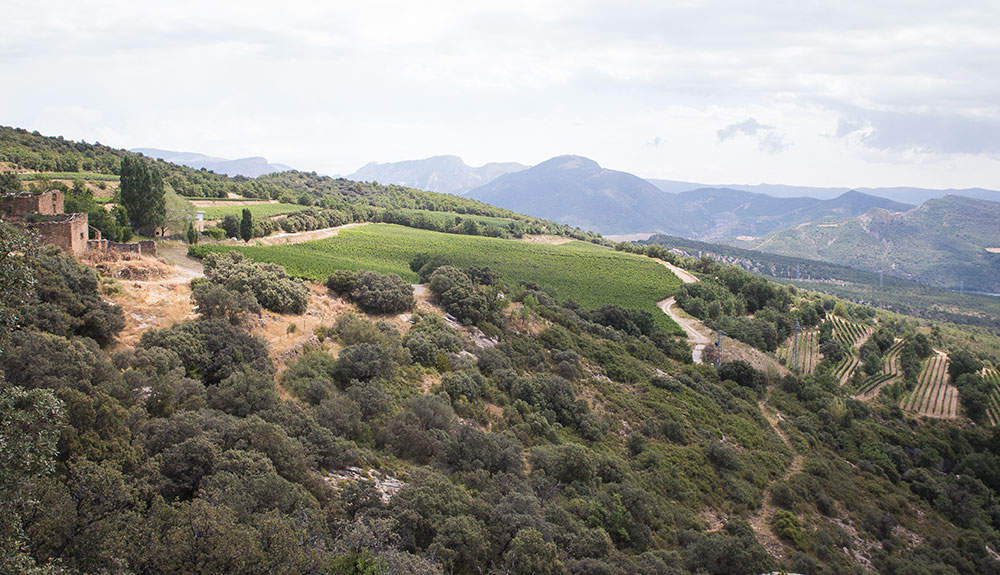
In looking at the general layout of Costers del Segre, the more southern part is the hills and small-ish mountains that are the most Mediterranean aspects of the region as a whole. While the subzones are technically called, Les Garrigues as well as Valls del Riucorb, the territory will be quite familiar to anyone who’s travelled around Catalunya as there’s a mix of oaks, shrubs and olives that the vines hide amongst and call home.
In fact, one of the wineries in this region, Clos Pons, saw its birth via the family earning money in olive production first before opening the winery in 2005 with their very nice winery opening in 2011. It’s a striking place set upon a hill with a wonderful view over part of their olive groves and vines.
Tucked away in these hills are other wineries of all different shapes and types. Tomás Cusiné is a key member of this area as he has his own eponymous winery and is also in charge of the cooperative of Cérvoles as well as Castell del Remei which exists a bit to the north. Cusiné has been a key part of Costers del Segre as he was the president for six years during which time they worked to consolidate the region.
Then there’s Matallonga who are a small, family winery working old plots they own and the daughter, Alba Penella, doing the enology.
In this zone there is also the aforementioned cooperative of l’Olivera, as well as Analec, and Boldú Viticultors who I hadn’t known before but are producing some exciting new wines. I wasn’t surprised to learn that son, Joan Boldú also works for the l’Enclòs de Peralba project in Penedès, who are likewise redefining the profile of the wines for that region.
Other wineries of note here are Mas Blanch i Jové and Torres’s Purgatori.
There are many rises and falls of the landscape when moving between these wineries, but it’s the Mediterranean aspect, along with a focus on the white variety, Macabeu that joins them together, not to mention the excellent olive oil which even has a DOP in Les Garrigues.
The middle plain
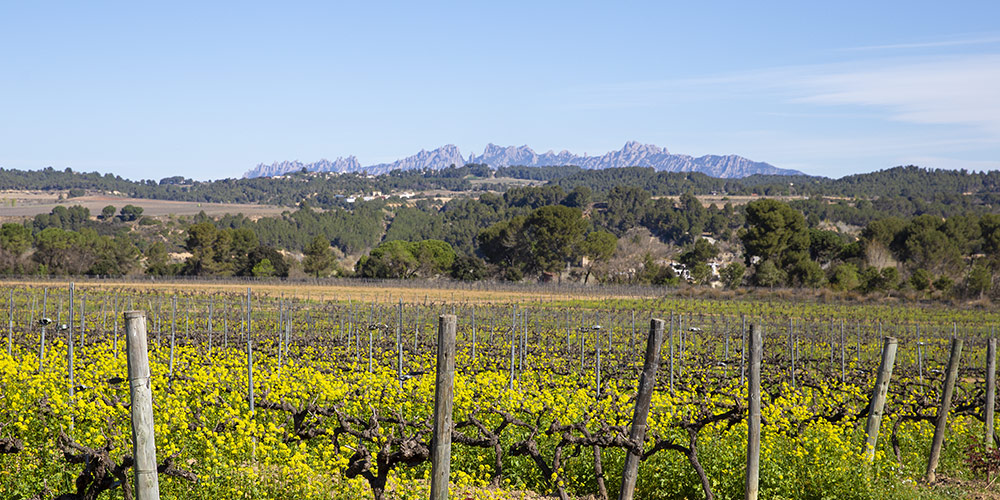
There are no hard lines in Lleida in terms of regions, but the plain upon which Lleida sits stands out as, it’s broad, flat and seemingly endless to the horizon. It more or less defines the width of the Lleida Province given that it starts in the east where Lleida abuts the other Catalan provinces and then keeps going, past the borders of Lleida and way out west beyond Huesca in neighboring Aragón and touching Navarra with its final tendrils.
If talking about subzones, these would be: lower Artesa de Segre, Raïmat (really a Monopole of the winery), Segrià, and Urgell.
Driving across this plain is only broken up by the tremendous rolling vineyards of Codorníu’s Raïmat just to the west of Lleida city. There are over 2,200ha that wrap through the flatlands and very low hills of the area. The only reason that they’re possible is due to the building of a canal running between Catalunya and Aragón. Without that, it’s simply too arid and the winery has gone to great lengths in creating very large reservoirs on their property to store water, as well as create wetlands habitats that people can cycle around. They have a very potent enotourism program as well.
It’s a similar concept for Castell del Remei which exists due to another canal built in the later 19th century by a family named, Girona, and allowed for tremendous farm plantings around a new castle that they built. Today there are ‘only’ 140ha of vines, but it’s overseen by Tomás Cusiné. The winery lays claims to luscious grounds and lakes that the original owners created, building up a farming ‘colony’ in what was otherwise quite barren lands. There’s also part of the Camino de Santiago that passes through the property.
Cusiné’s family had to do a great deal of work to bring the winery back into shape once buying it in 1982. As Tomás stating when visiting it, “There were 6,000 barrels just sitting in the cellar.” Dealing with those as well as heavily modernizing the winery have both been a tremendous amount of work during the decades.
Moving up more into the hills just to the north of Lleida in Alfarràs is the winery, Lagravera. The winery design is striking, but also their direction in using a rather massive list of grapes in old vineyards found around their location. They make the claim that they have the oldest producing vineyard in Catalunya, called “El Vinyet” that was planting in 1889 and has 24 different varieties in it, some of which were otherwise lost such as the as-of-yet-nicely-named X8, X Avi 1997, and X Avi 2167.
While all of this area in the middle of Lleida produces a great quantity of grapes, it’s also one of the most visitable and accessible parts. The history might be a touch more ‘modern’ but the scope of the wineries is quite grand in general.
Up into the mountains
Then we come to the place where things go up in hurry with the regions of upper Artesa de Segre and Pallars Jussà. These are the sharp mountains of the Pyrénées and it’s very easy to find yourself traipsing through a vineyard with a ski slope looming above you. The land gets rugged and the contours much more extreme with vineyards from 350-1,000m and even a couple of them at 1,200m.
Everything goes here and while the lower areas of Costers del Segre focus more on Mediterranean varieties and the plains on international, winery owners in this area try everything that might make sense when growing in what is a near-alpine climate.
For example, Castell d’Encus and Batlliu de Sort produce the only two varietal Pinot Noirs in all of Spain that worth searching out. Encus also makes a great Merlot and Batlliu very nice Rieslings as well as Solana Roivert which is about 40km down the road from Batlliu.
These wineries are exciting and the territory is gorgeous. The only catch is that it’s definitely more challenging to visit as there are far fewer wineries and getting around requires a car, although there’s what is probably one of the most scenic trains in all of Iberia (although the one to Douro is up there too) which goes from Lleida to el Poble de Segur.
But those who farm grapes up in this area are working almost exclusively with foreign varieties given the extreme climate and altitude. They’re very much at the fringe, but at the same time, worth checking out.
Traveling to eat and drink well
It’s good to get a general understanding of the wineries in DO Costers del Segre as with that under your belt, you can get down to something else that matters a great deal, eating well.
I’ve never had a bad meal anywhere in Lleida. I’ll fully admit that people might be turned off when looking photos on Google Maps as snails feature very prominently as it’s a local dish that Catalans eat a great deal of. If it’s not your thing, don’t worry as there’s much more to discover and I venture so far as to say that it’s not Barcelona nor the coast of Catalunya with leading cuisine, but the interior of Lleida now.
In Lleida city, I’ve had tremendous meals at Ferreruela, Saroa, and el Celler del Roser, not to mention great coffee and pastries at Delsams de Café, bread at Pa Pan Bread, and even just a good snack with a great selection of beer at Bocao. All of the restaurants are supported by a very nice selection of the Costers del Segre wines. In fact, I’ve been to few regions in Europe that support their local winemakers to such a level, especially when visiting places like Alicante where it seems restaurants are downright hostile to local wines.
But outside of Lleida city, there’s this similar quality to the region that one finds in France where it seems like every village holds one if not several very nice restaurants. Heading to Ca la Margarida in Albí or Cal Menut in Belianes or then up in the mountains at Hotel Pessets in Sort is nothing short of wonderful.
Meals show a blend of interior, mountain dishes based around meats, but there’s always plenty of seafood as well as fish both from the sea as well as rivers to be had and again, it’s all in this lovely, interior setting and based upon the local wines. And they can range from very traditional, well-cooked meals up to modern mountain gastronomy.
This trip came about because of talking with the DO Costers del Segre and wanting to see more of the territory than just a one-day visit for tasting wines or visiting a winery here and there. Also, I finally had the opportunity to visit the interior of the impressive la Seu Vella and its importance to wine via a guide from Nomon.
Thankfully it was possible to make it happen via a longer stay in the region as they arranged the itinerary with over a dozen new winery visits and eating throughout all of the region. The only thing it makes me want to do is spend even more time there and very soon as driving around, I saw countless places in need of further exploration as well as more wines to taste.
Please see the accompanying wine Tasting Report for further reference.